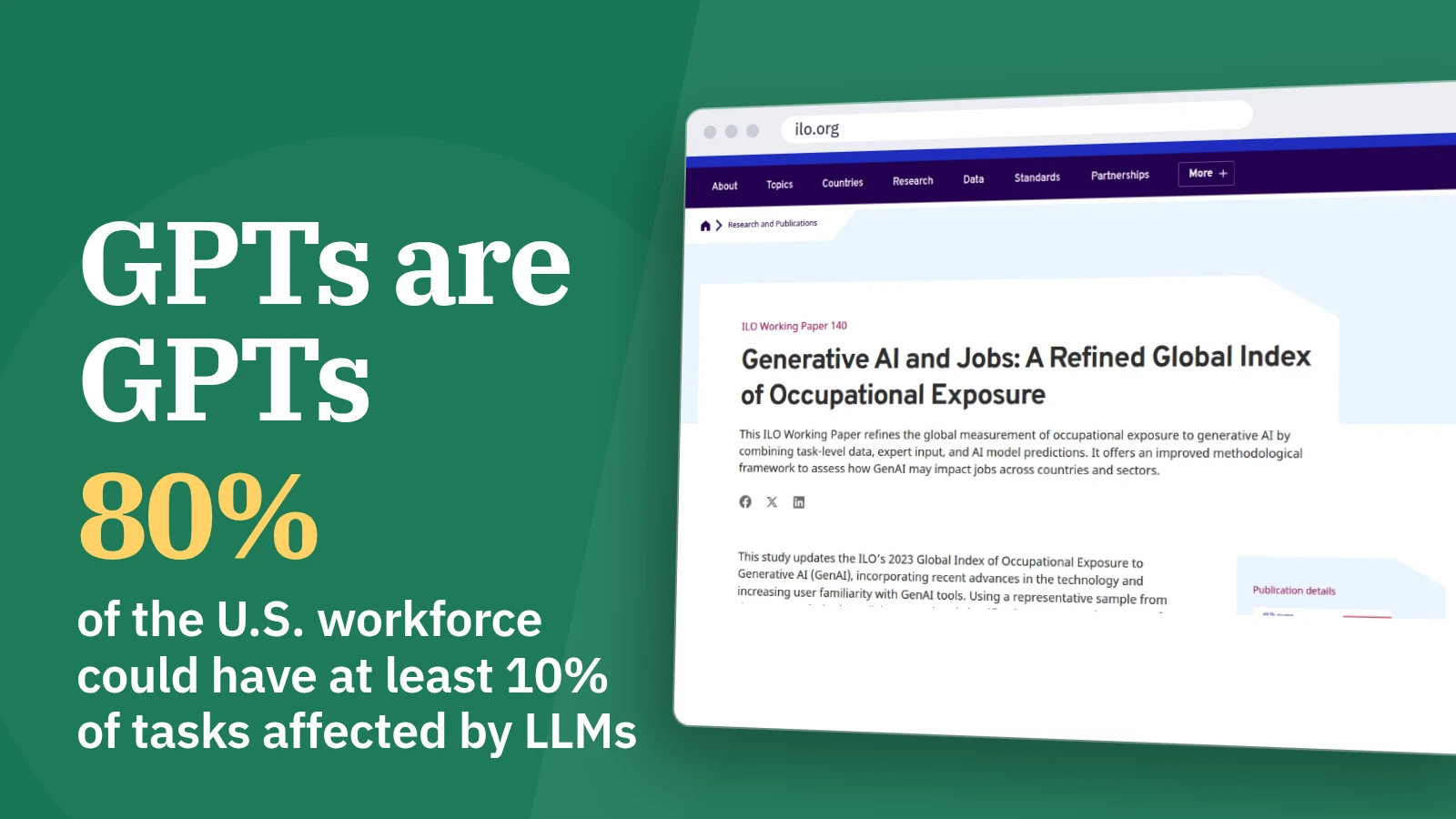
The studies measure exposure of tasks and occupations to AI, not a list of jobs that will disappear, and their headline figures differ because they measure different things. The GPTs are GPTs paper states that around 80% of the U.S. workforce could have at least 10% of work tasks affected by LLMs, and about 19% could see at least 50% of tasks affected (arxiv.org). The ILO’s refined index states that globally one in four workers are in an occupation with some GenAI exposure.
The five studies side by side
| Study | Read on | Published | What it measures | Data it uses | Main finding it states |
|---|---|---|---|---|---|
| GPTs are GPTs: An Early Look at the Labor Market Impact Potential of Large Language Models | GPTs are GPTs (2023) | 17 Mar 2023 | we assess occupations based on their alignment with LLM capabilities | integrating both human expertise and GPT-4 classifications | around 80% of the U.S. workforce could have at least 10% of their work tasks affected by the introduction of LLMs |
| How will Language Modelers like ChatGPT Affect Occupations and Industries? | How will Language Modelers like ChatGPT Affect Occupations and Industries? (2023) | 2 Mar 2023 | the extent to which occupations, industries and geographies are exposed to advances in AI language modeling capabilities | — | the top occupations exposed to language modeling include telemarketers and a variety of post-secondary teachers |
| Which Economic Tasks are Performed with AI? Evidence from Millions of Claude Conversations | Which Economic Tasks are Performed with AI? (2025) | 11 Feb 2025 | measuring AI usage patterns across the economy | over four million Claude.ai conversations | AI usage primarily concentrates in software development and writing tasks, which together account for nearly half of all total usage |
| Working with AI: Measuring the Applicability of Generative AI to Occupations | Working with AI (2025) | 10 Jul 2025 | measure AI applicability to occupations | a dataset of 200k anonymized conversations with Microsoft Bing Copilot | the most common and successful AI-assisted work activities involve information work |
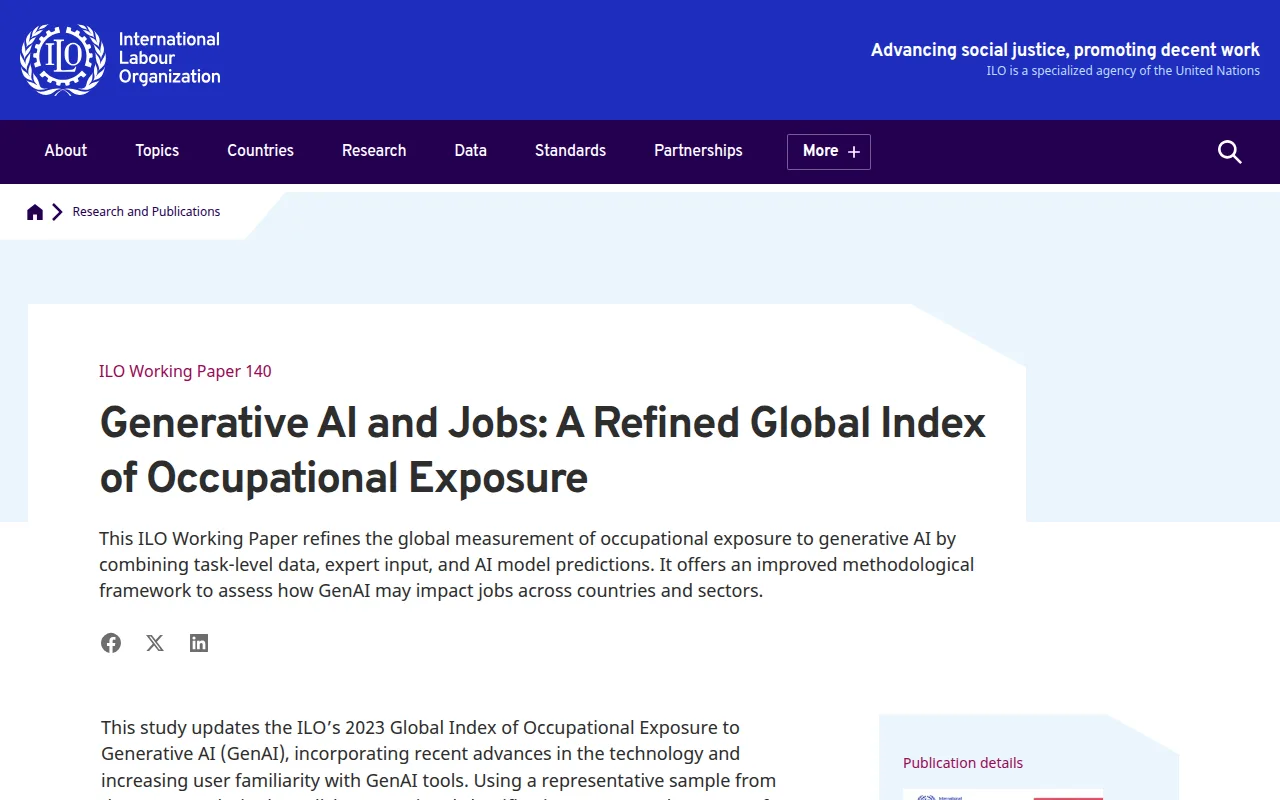
| Generative AI and Jobs: A Refined Global Index of Occupational Exposure | ILO refined global index of occupational exposure | — | refines the global measurement of occupational exposure to generative AI | a survey of 1,640 people employed in each 1-digit ISCO-08 groups | Globally, one in four workers are in an occupation with some GenAI exposure. |
The table lists each study with what it measures, the data it uses and the main finding as its own abstract words it. Reading across the table shows two families of method: the two March 2023 papers assess occupations against what language models can do, while the two 2025 papers start from real conversations. The first paper combines human expertise with GPT-4 classifications, while the Claude conversations study analyzes over four million Claude.ai conversations, so one rates potential and the other observes usage (arxiv.org). The Microsoft paper sits between them: its dataset is 200k anonymized Bing Copilot conversations, and its finding concerns the most common and successful AI-assisted work activities, which makes it a usage study as well. The ILO row differs again, because its data combines a survey of 1,640 people with expert discussions and the predictions of an AI assistant, rather than chat logs (ilo.org). For that reason the percentages in the GPTs are GPTs row and the ILO row should not be put on one scale: one concerns the share of the U.S. workforce whose tasks could be affected, the other the share of workers worldwide in an occupation with some GenAI exposure.
Exposure is not replacement
The reader’s question is which jobs AI will replace, but the abstracts in the table describe exposure, applicability and usage. The ILO page describes its work as refining the global measurement of occupational exposure to generative AI. The Microsoft paper says it measures AI applicability to occupations. Treat each figure below as a measure of where AI touches work, and keep job loss as a separate question.
The two 2023 papers: capability-based estimates
The GPTs are GPTs paper, published 17 Mar 2023, says it assesses occupations by their alignment with LLM capabilities. Its estimate, in its own words, is that around 80% of the U.S. workforce could have at least 10% of work tasks affected, while approximately 19% of workers may see at least 50% of tasks impacted. The two thresholds matter: the 80% figure is a low bar of at least 10% of tasks, and the 19% figure applies to a much higher bar of at least 50%. Felten, Raj and Seamans, in the paper published 2 Mar 2023, present a methodology to assess exposure of occupations, industries and geographies to advances in AI language modeling (arxiv.org). They find that telemarketers and a variety of post-secondary teachers are among the most exposed occupations, and that legal services and securities, commodities and investments are among the most exposed industries. Both papers are about language models, so their rankings favor work done with text and speech; that is a reading of the method, not a claim from the papers.
The 2025 studies: what people actually do with AI
The study of Claude conversations, submitted on 11 Feb 2025, analyzes over four million Claude.ai conversations through the tasks and occupations in the U.S. Department of Labor’s O*NET Database. It reports that usage concentrates in software development and writing tasks, which together account for nearly half of all total usage. This is usage on one assistant’s platform, so it describes who chooses to use that tool and for what, and it should not be read as the whole economy. The Microsoft paper, published 10 Jul 2025, analyzes a dataset of 200k anonymized conversations with Microsoft Bing Copilot to measure AI applicability to occupations (arxiv.org). Its stated finding is that the most common and successful AI-assisted work activities involve information work. The paper’s abstract points to a GitHub address, microsoft/working-with-ai, for its AI applicability scores and component usage and success metrics. Two different chat tools, two different samples, and a similar emphasis on writing and information work: that overlap is an observation for the reader to weigh, not a finding either paper reports about the other.
The ILO view: a global index with a gender split
The ILO page states that globally one in four workers are in an occupation with some GenAI exposure. It also states that 3.3% of global employment falls into the highest exposure category, with significant differences between female employment at 4.7% and male employment at 2.4%. The index draws on a survey of 1,640 people employed in each 1-digit ISCO-08 groups, according to the table’s reading of the ILO page. Set against the U.S. paper, the ILO figures show that the share of workers in the top category is small, while exposure of some kind is far more common.
How we built this
Guide tableFive studies of AI exposure by occupation, as their abstracts state them
Every cell was read on the official page named in the column "Read on", on 2026-11-18: each value was taken with the line of the page that holds it, and our code kept it only when that line is on the page and holds the value word for word. An empty cell means no line of the page gave that value in a form our code could match.
Sources
The sources this article was written from. Links open the original page.
- arxiv.orgGPTs are GPTs: An Early Look at the Labor Market Impact Potential of Large Language Modelsarxiv.org
- arxiv.orgHow will Language Modelers like ChatGPT Affect Occupations and Industries?arxiv.org
- arxiv.orgWhich Economic Tasks are Performed with AI? Evidence from Millions of Claude Conversationsarxiv.org
- arxiv.orgWorking with AI: Measuring the Applicability of Generative AI to Occupationsarxiv.org
- ilo.orgGenerative AI and Jobs: A Refined Global Index of Occupational Exposure | International Labour Organizationilo.org